
Question 2 Paper 1

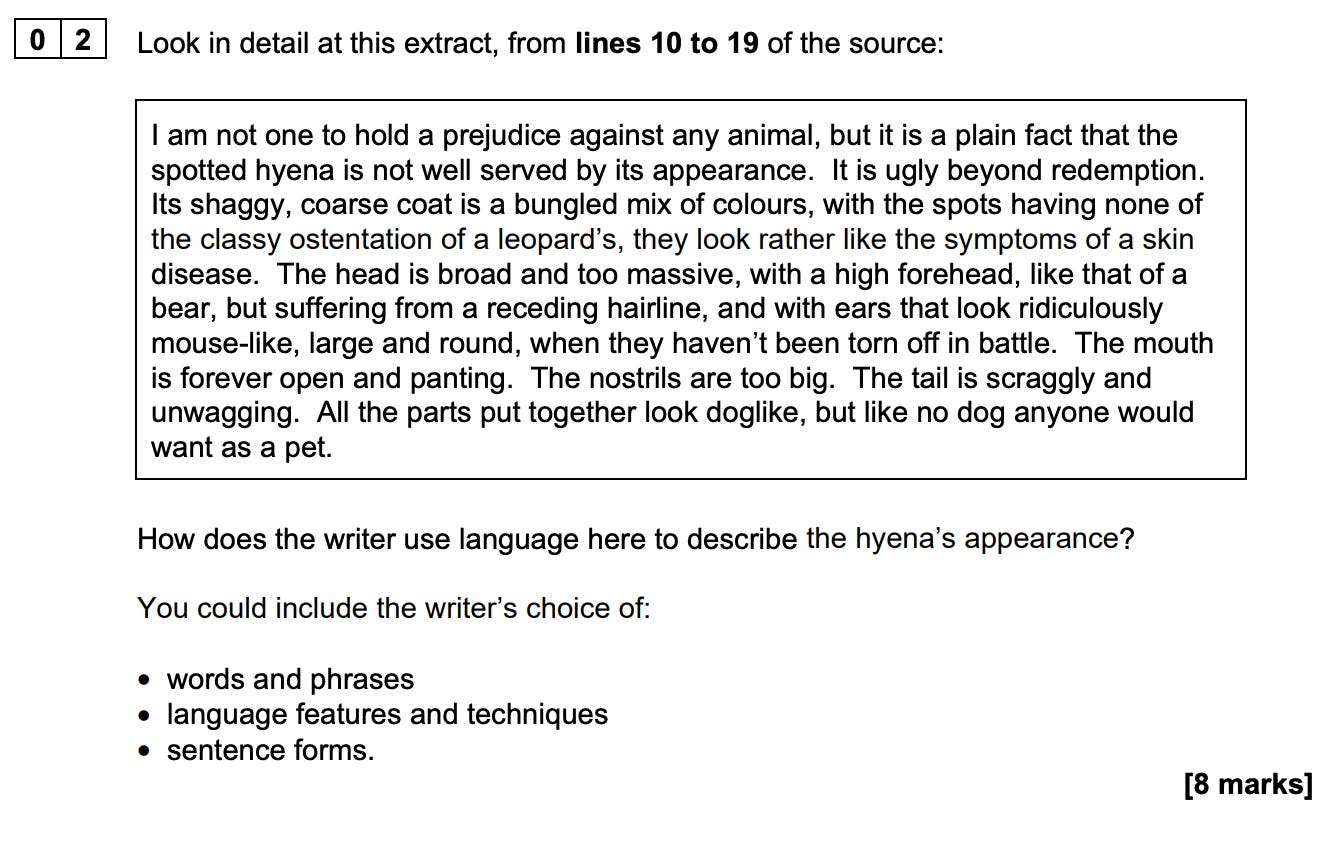
The writer describes the hyena’s appearance as hideous and undesirable. To begin with Martel describes the hyena as “not well served by its appearance” suggesting it has an unfortunate appearance which does not suit it. A reader may pity the creature for this matter. The author then uses the hyperbole “ugly beyond redemption” to suggest that not even a heaven-sent miracle could fix the poor creatures’ looks as they are so ugly.
Martel also uses metaphor to describe the spotted hyena’s coat as “a bungled mix of colours” as though it doesn’t seem to have all of the same fur and has instead borrowed the colours of other creatures in a mangy manner. Furthermore, by comparing the hyena’s spots to those of a leopard’s by saying the hyena has “none of the classy ostentation of a leopard’s” it implies that despite similarities with other species a hyena will never be mistaken for another. If you look more closely, the word “classy” used not to describe the hyena suggests it has a wild and inelegant nature in comparison to more agile creatures like leopards.
Martel mentions the hyena’s spots in an even more negative way when he uses the simile, “like the symptoms of a skin disease.” This insulting description depicts the hyena to appear permanently diseased and unkempt.
Finally, Martel describes the hyena’s body parts as individually dog-like however when put together they are “like no dog anyone would want as a pet.” This final description finalises the disgust felt by those who look at a hyena and how severely revolting and un-loveable the species is.
You’ll learn a lot more from this post if you mark this yourself first.
Tilf Marking
Tilf doesn’t pay me, or sponsor me. I just think it is fab.
If you like it, use my Promo Code, SALLES10 - I get half a cup of coffee for this, so you can subscribe to Tilf without the Promo Code if you would rather.
What Went Well
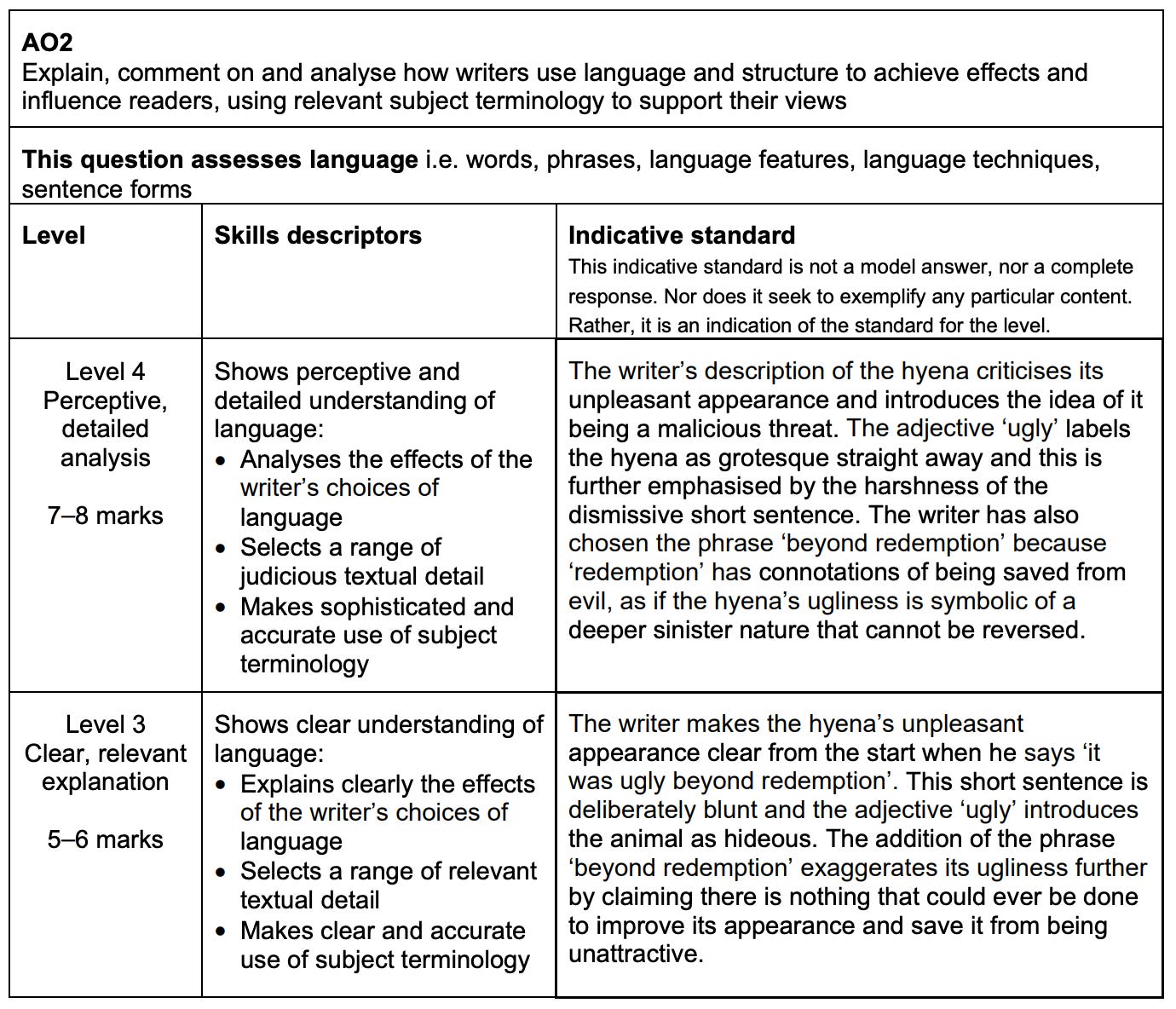
You effectively identify various language techniques used by the writer, such as hyperbole, metaphor, and simile, which demonstrates a clear understanding of how language can shape a reader’s perception.
Your use of specific examples from the text supports your analysis, showing that you can connect language choices to their effects on the reader.
The progression of your analysis from the hyena’s appearance to the emotional responses it evokes is logical and helps to build a comprehensive understanding of the writer’s intentions.
Even Better If
To achieve a higher mark, you should delve deeper into the emotional effects of the language used. For instance, explain how the descriptions not only depict the hyena but also reflect broader themes in the text.
Incorporate more subject terminology related to language analysis, such as ‘connotation’ and ‘tone’, to enhance the sophistication of your response.
Consider the overall impact of the language on the reader’s experience. Discuss how the cumulative effect of these descriptions shapes the reader’s attitude towards the hyena throughout the text.
Stronger Writing
Instead of just stating that the hyena’s appearance is ‘ugly beyond redemption’, you could expand this idea by saying, ‘The hyperbole ‘ugly beyond redemption’ not only emphasizes the hyena’s grotesque appearance but also evokes a profound sense of pity and revulsion in the reader, suggesting that the creature is beyond the hope of beauty or acceptance.’
Mark 8/8
I like the way Tilf tries to improve every paragraph and every answer, even if you are already at 100%. I always rate Tilf’s Even Better Ifs. But, I don’t always agree with the mark.
(Ofqual finds that 50% of examiners give not just the wrong mark, but the wrong grade! Tilf is better than that)
Points Make Prizes
Language terminology,
with quotes in bold,
and explanations in italics:
The writer describes the hyena’s appearance as hideous and undesirable. To begin with Martel describes the hyena as “not well served by its appearance” suggesting it has an unfortunate appearance which does not suit it. A reader may pity the creature for this matter. (1 explanation)
The author then uses the hyperbole “ugly beyond redemption” to suggest that not even a heaven-sent miracle could fix the poor creatures’ looks as they are so ugly. (2 explanations)
Martel also uses metaphor to describe the spotted hyena’s coat as “a bungled mix of colours” as though it doesn’t seem to have all of the same fur and has instead borrowed the colours of other creatures in a mangy manner. (3 explanations)
Furthermore, by comparing the hyena’s spots to those of a leopard’s by saying the hyena has “none of the classy ostentation of a leopard’s” it implies that despite similarities with other species a hyena will never be mistaken for another. (Not really a valid explanation)
If you look more closely, the word “classy” used not to describe the hyena suggests it has a wild and inelegant nature in comparison to more agile creatures like leopards. (4 explanations - just about valid)
Martel mentions the hyena’s spots in an even more negative way when he uses the simile, “like the symptoms of a skin disease.” This insulting description depicts the hyena to appear permanently diseased and unkempt. (5 explanations)
Finally, Martel describes the hyena’s body parts as individually dog-like however when put together they are “like no dog anyone would want as a pet.” This final description finalises the disgust felt by those who look at a hyena and how severely revolting and un-loveable the species is. (6 explanations)
So - 6 marks.
This is another reason Points Make Prizes is such a great method - it gets you much closer to the senior examiner’s mark. How do I know?
I sat the exam twice in June 2025 and November 2025 to test it. The Senior Examiner wrote to me to agree that the number of valid explantions is what works.
You can see how this works at every single grade. My practice papers have answers at every grade, written in the real exams and marked by senior examiners. Each and every one shows you the Points Make Prizes method.
It is easy.

You don’t have to get all 3 - that’s just the most value for money.