
When everything else lets you down, there's always poetry
Meet the unseen poem

I used to write a lot of poetry. Not in a competitive way, nor to perform artfully in Poetry Slams, not even to publish.
I wrote poems because they captured important moments - just before and just after loss. This is my definition of a poem.
We can try it with Power and Conflict and Love and Relationships.
Power and Conflict
All 15 poems explore some form of loss.
The type of loss varies:
Personal or emotional loss: Poppies, Remains, Kamikaze, War Photographer, The Prelude
Moral or psychological loss: My Last Duchess, Bayonet Charge, London
Cultural or identity loss: Checking Out Me History, The Emigree, Tissue
Physical loss (death or destruction): Ozymandias, Charge of the Light Brigade, Exposure
Spiritual or existential loss: Storm on the Island, Exposure
Sure, AQA says they are about power and conflict. But I think loss is the unifying principle of all poems.
Love and Relationships
Romantic or emotional loss: When We Two Parted, Love’s Philosophy, Neutral Tones, Porphyria’s Lover, Sonnet 29, Winter Swans
Familial or generational loss: Walking Away, Follower, Mother, Any Distance, Before You Were Mine, Eden Rock, Climbing My Grandfather
Loss of connection or intimacy: The Farmer’s Bride, Neutral Tones, Winter Swans
Loss of identity or independence: Before You Were Mine, The Farmer’s Bride, Singh Song!
Physical or spatial loss (distance or death): Letters from Yorkshire, Sonnet 29, Eden Rock
In my 20s, 30s and early 40s I would suddenly feel moved - some important moment, or feeling had to be preserved in the amber of a poem’s tight lines.
But then it became more difficult. You lose so much as you hit middle age. I won’t list you all the ways, because I am very much a glass half full person.
But, it is difficult to write poems without draining the glass. Loss is chasing you from all sides and poetry just gives it a head start. I spend a lot of my life finding ways to make it difficult for grief to find me.
But I’m thinking more about poems these days. Here’s one that found me in Egypt, sitting in a hotel lobby in Luxor, fresh from the wonders of Rameses II and Tutankhamun.
A poem about love (and of course loss).
WHAT I DIDN’T KNOW BEFORE
was how horses simply give birth to other
horses. Not a baby by any means, not
a creature of liminal spaces, but already
a four-legged beast hellbent on walking,
scrambling after the mother. A horse gives way
to another horse and then suddenly there are
two horses, just like that. That’s how I loved you.
You, off the long train from Red Bank carrying
a coffee as big as your arm, a bag with two
computers swinging in it unwieldily at your
side. I remember we broke into laughter
when we saw each other. What was between
us wasn’t a fragile thing to be coddled, cooed
over. It came out fully formed, ready to run.
By Ada Limon
Poems are …
Poems are always about loss.
They are also best when they show you familiar things in a new way. They are even better when the thing you see is forever changed, by the poem.
Now, I will never see a newborn horse as anything other than the perfect companion, but also the perfect halving of its mother.
Now I will believe in love at first sight, and wonder at it and fear it. If only Romeo and Juliet had understood and felt this poem!
And of course, there is loss. It isn’t just the mother who has lost. “That’s how I loved you.” The past tense doesn’t register the first time. The fist time, it is a celebration of love.
The last line, the first time, was a celebration of the miracle of love. Here, fully formed, like a freshly born foal, “ready to run”.
But not now.
Now, on the second reading, the horse was always running, always ready to leave. The mother horse will always be less - because the mother is halved again with each new birth.
And the foal is always running, and running can take you far away.
Go back again and look at those two lines. They are the only two which end with a full stop. They are end stopped. They are the end. Every other line carries over, enjambment spilling over in excitement at the suddenness and the perfection of love.
But the metaphor of the horse shows us that though this love is beautiful, it is also doomed.
If you are meeting a poem for the first time, in real life, or in the exam, ask yourself this question: what has been lost? You’ll gain insights few other students have understood.
That’s grade 9. It’s not that hard.
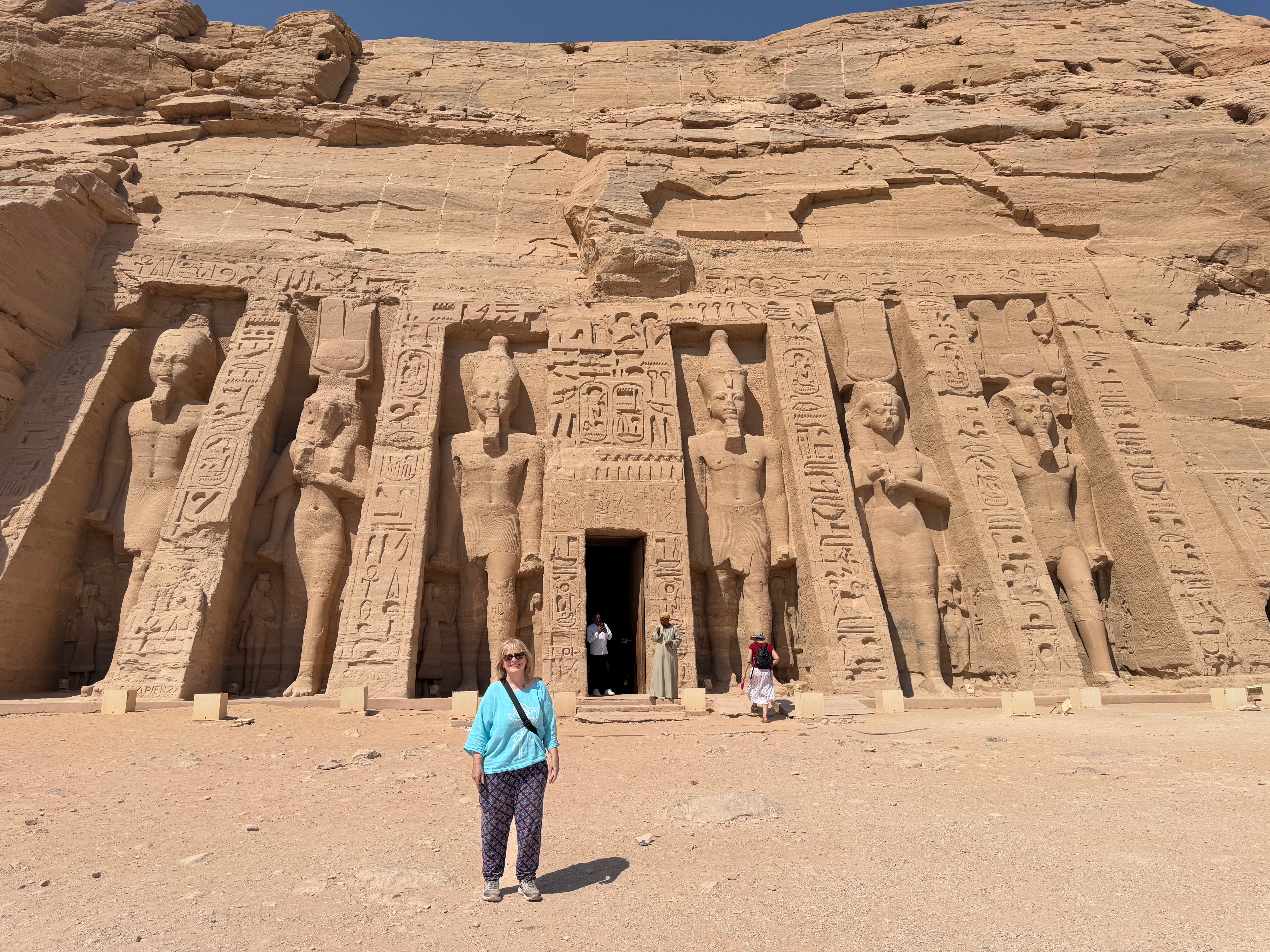
Nefertari
This is the temple Rameses II built for his Nubian wife, Nefertari. She fell ill when he was building it and she died, aged 23.
Kings could marry as many wives as they liked. Rameses refused to marry while Nefertari was alive. But, once she died, he married 50 more times. They were, in comparison to Nefertari, just status symbols and breeders of heirs. He is believed to have fathered over 100 children.
He reigned for 67 years, and died aged around 90. This temple, in Abu Simbel, is the only occasion in all of Egyptian history where a king portrayed his wife as the same height as him. She was his equal.
He dramatised that a step further. His temple is built right next door - and he stopped the building work when Nefertari grew sick, so he could finish her temple first.
I can’t tell you how beautiful these temples are. But there will be videos on my travel channel - you might chance upon them some day.
Yet, Nefertari died. So Rameses II never visited either temple.
P.S.
Rameses II was Ozymandias. Poor old Shelley had no idea how much of Rameses II remained in Egypt. His statues and monuments and temples are everywhere - he is the most prolific builder of all time.
The lone and level sands have been scraped away. Rameses lives.
This is a love poem
That’s my wife, standing in front of the temple. She doesn’t read this, so it is safe to say this out loud. I love her still.
My kids don’t read this either, but they have halved her twice already.
And, you know, she was only 4’11” to start with.
This has moved me so much and made me see poems in a completely new light!
Show Mrs S this post ❤️! Loss has made me realise we don’t tell those we love that we love them enough.