
Paper 2 Question 3 Full Mark Answer
Ritika

This answer comes from Ritika, a grade 9 student. Thanks Ritika.
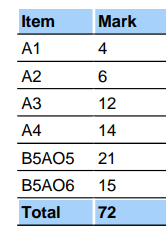

Source A
This extract is from a diary written by a young doctor, Adam Kay, published in 2017. Here, he writes about training to be a doctor at medical school and then his first experiences of working in a hospital as a ‘house officer’, the lowest rank of junior doctor.
Because medical schools are oversubscribed ten-fold, all candidates must be interviewed, with only those who perform best under a grilling being awarded a place. It’s assumed all applicants are on course for straight A grades at A-level, so universities base their decisions on non-academic criteria.
Imperial College in London were satisfied that my distinctions in grade eight piano and saxophone, alongside some half-hearted theatre reviews for the school magazine, qualified me perfectly for life on the hospital wards, and so in 1998 I packed my bags and embarked upon the treacherous six-mile journey from Dulwich to South Kensington.
As you might imagine, learning every single aspect of the human body’s anatomy and physiology, plus each possible way it can malfunction, is a fairly gargantuan undertaking. But the buzz of knowing I was going to become a doctor one day – such a big deal you get to literally change your name, like a superhero or an international criminal – propelled me towards my goal through those six long years.
Then there I was, a junior doctor. I could have gone on a quiz show with the specialist subject ‘the human body’. Everyone at home would be yelling at their TVs that the subject I’d chosen was too vast and wide-ranging, that I should have gone for something like ‘atherosclerosis’ or ‘bunions’, but they’d have been wrong. I’d have nailed it.
It was finally time to step out onto the ward armed with all this exhaustive knowledge and turn theory into practice. My spring couldn’t have been coiled any tighter. So it came as quite the blow to discover that I’d spent a quarter of my life at medical school and it hadn’t remotely prepared me for the unpredictable existence of a house officer.
During the day, the job was manageable, if mind-numbing and insanely time-consuming. You turn up every morning for the ‘ward round’, where your whole team of doctors pootles past each of their patients. You trail behind like a hypnotized duckling, your head cocked to one side in a caring manner, noting down every pronouncement from your seniors – book an MRI scan, refer to rheumatology, arrange an ECG test. Then you spend the rest of your working day (plus generally a further unpaid four hours) completing these dozens, sometimes hundreds, of tasks – filling in forms, making phone calls. Essentially, you’re a glorified personal assistant. Not really what I’d trained so hard for, but whatever.
The night shifts, on the other hand, made Hell look like Disneyland – an unrelenting nightmare that made me regret ever thinking my education was being wasted. At night, the house officer is given a little paging device affectionately called a ‘bleep’, and responsibility for every patient in the hospital. Your senior colleagues are seeing patients in A&E with a specific problem, like pneumonia or a broken leg, while you’re up on the wards, sailing the ship alone. A ship that’s enormous, and on fire, and that no one has really taught you how to sail. You’re bleeped by ward after ward, nurse after nurse, with emergency after emergency – it never stops, all night long. You’re a one-man, mobile, essentially untrained A&E department, getting drenched in bodily fluids, reviewing an endless stream of worryingly sick patients who, twelve hours earlier, had an entire team of doctors caring for them.
You’ve been trained how to examine a patient’s cardiovascular system, but, even when you can recognize every sign and symptom of a heart attack, it’s very different to actually managing one for the first time. You suddenly long for the sixteen-hour admin sessions. (Or, ideally, some kind of compromise job, that’s neither massively beyond nor beneath your abilities.)
It’s sink or swim, and you have to learn how to swim because otherwise a ton of patients sink with you. I actually found it all perversely exhilarating. Sure it was hard work, sure the hours were bordering on inhumane and sure I saw things that have scarred my retinas to this day, but I was a doctor now.
Have a go at this yourself before you read Ritika’s answer!
Tilf
What Went Well
The essay demonstrates a clear understanding of the emotional weight of working night shifts, using strong metaphors and allegories to convey the author’s experience.
The use of contrasting imagery, such as ‘Hell’ and ‘Disneyland,’ effectively highlights the stark differences between the author’s expectations and reality, providing a deep emotional context.
The analysis of the extended metaphor of the ship is insightful, as it explores themes of isolation and the complexities of the medical profession, which adds depth to the discussion.
Even Better If
The analysis could be more focused on specific language choices and their direct effects on the reader, rather than broader interpretations that may detract from the main argument.
Including more textual evidence, such as direct quotes, would strengthen the analysis and provide clearer connections between the writer’s points and the language used.
Clarifying complex phrases and ensuring that all terms used are accessible to the reader will enhance the overall clarity and impact of the essay.
Mark 12
If you like Tilf, use my Promo Code SALLES10 for a 10% discount.
I am not sponsored by TILF - I promote them because I think the feedback is brilliant every time, and the marking is very good 80% of the time.
✅ Paid subscribers get a grade 9 answer with my comments every week except the summer holidays, and access to the over 350+ already published. 🎓
✅ Substack thinks this is so good, that you can sample them free for a week. 👏
✅ Paid subscribers get the answer typed up, with my explanation of Points Make Prizes, and my full analysis of the student’s skills.
The Typed Answer
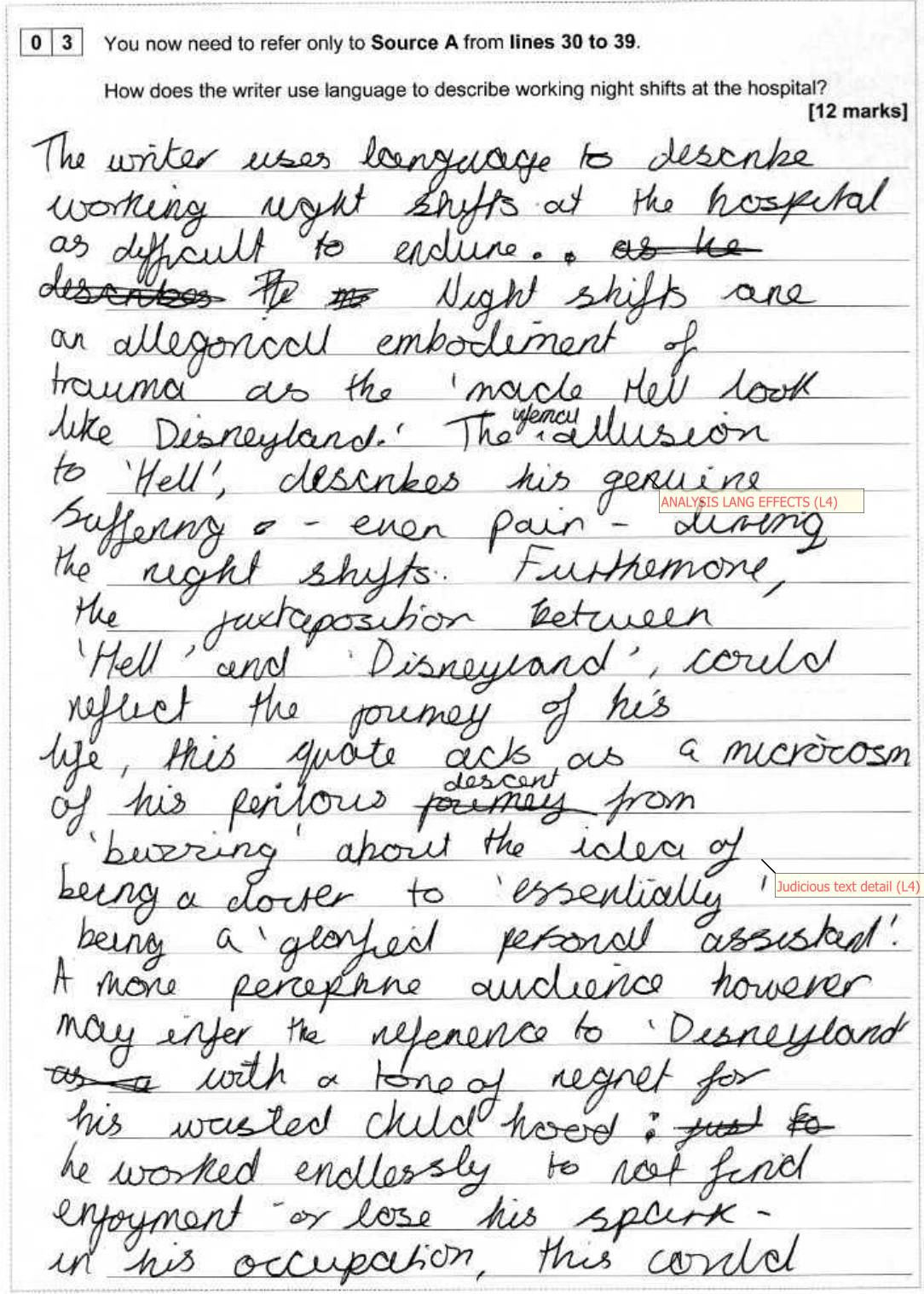
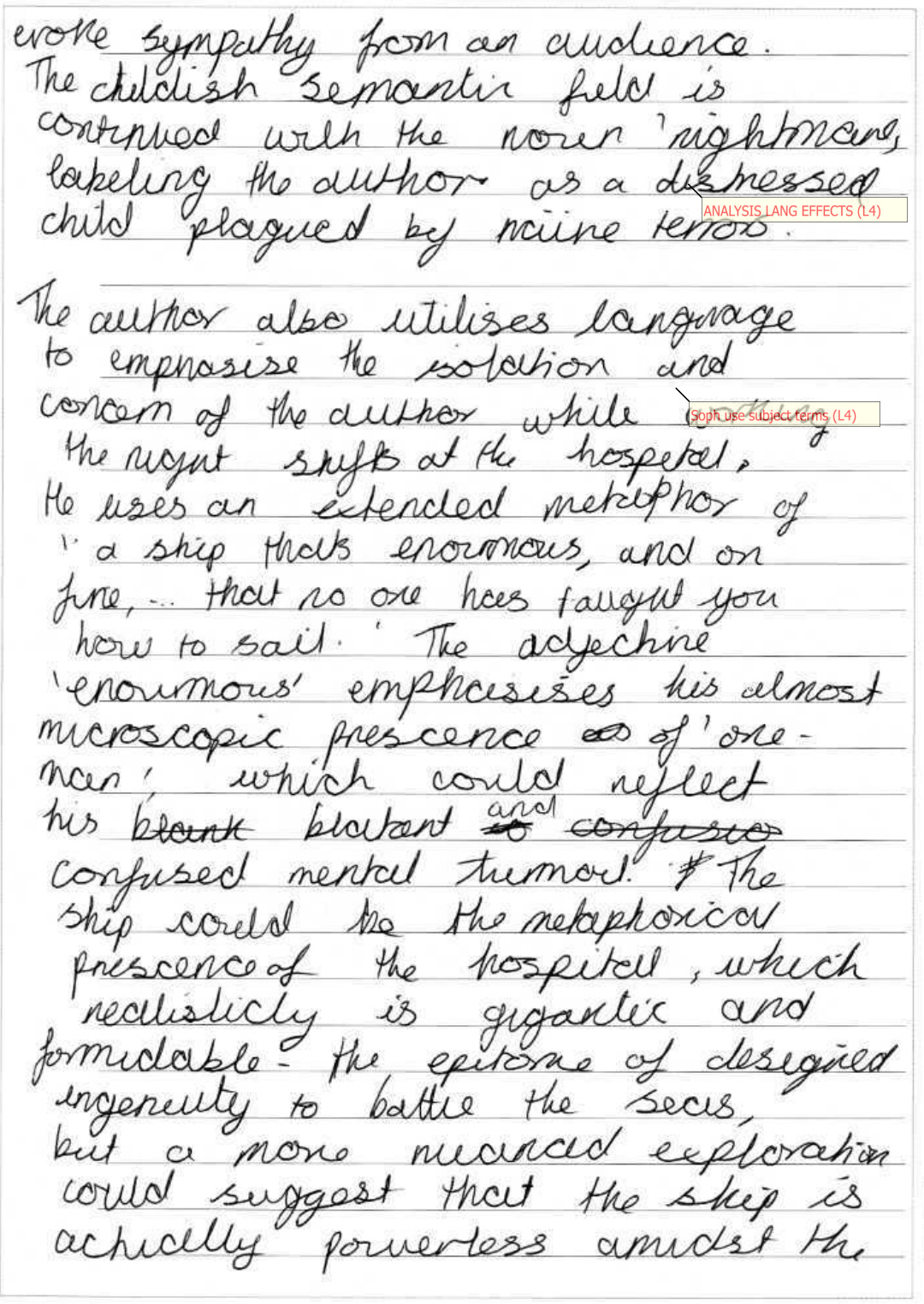
The writer uses language to describe working night shifts at the hospital as difficult to endure. Night shifts are an allegorical embodiment of trauma as they ‘made Hell look like Disneyland.’ The inferential allusion to ‘Hell’, describes his genuine suffering - even pain - during the night shifts. Furthermore, the juxtaposition between ‘Hell’ and ‘Disneyland’, could reflect the journey of his life, this quote acts as a microcosm of his perilous descent from ‘buzzing’ about the idea of being a doctor to ‘essentially being a ‘glorified personal assistant’.’ A more perceptive audience however may infer the reference to ‘Disneyland’ with a tone of regret for his wasted childhood; he worked endlessly to not find enjoyment - or lose his spark - in his occupation, this could evoke sympathy from an audience. The childish semantic field is continued with the noun ‘nightmare’, labeling the author as a distressed child plagued by naive terror.
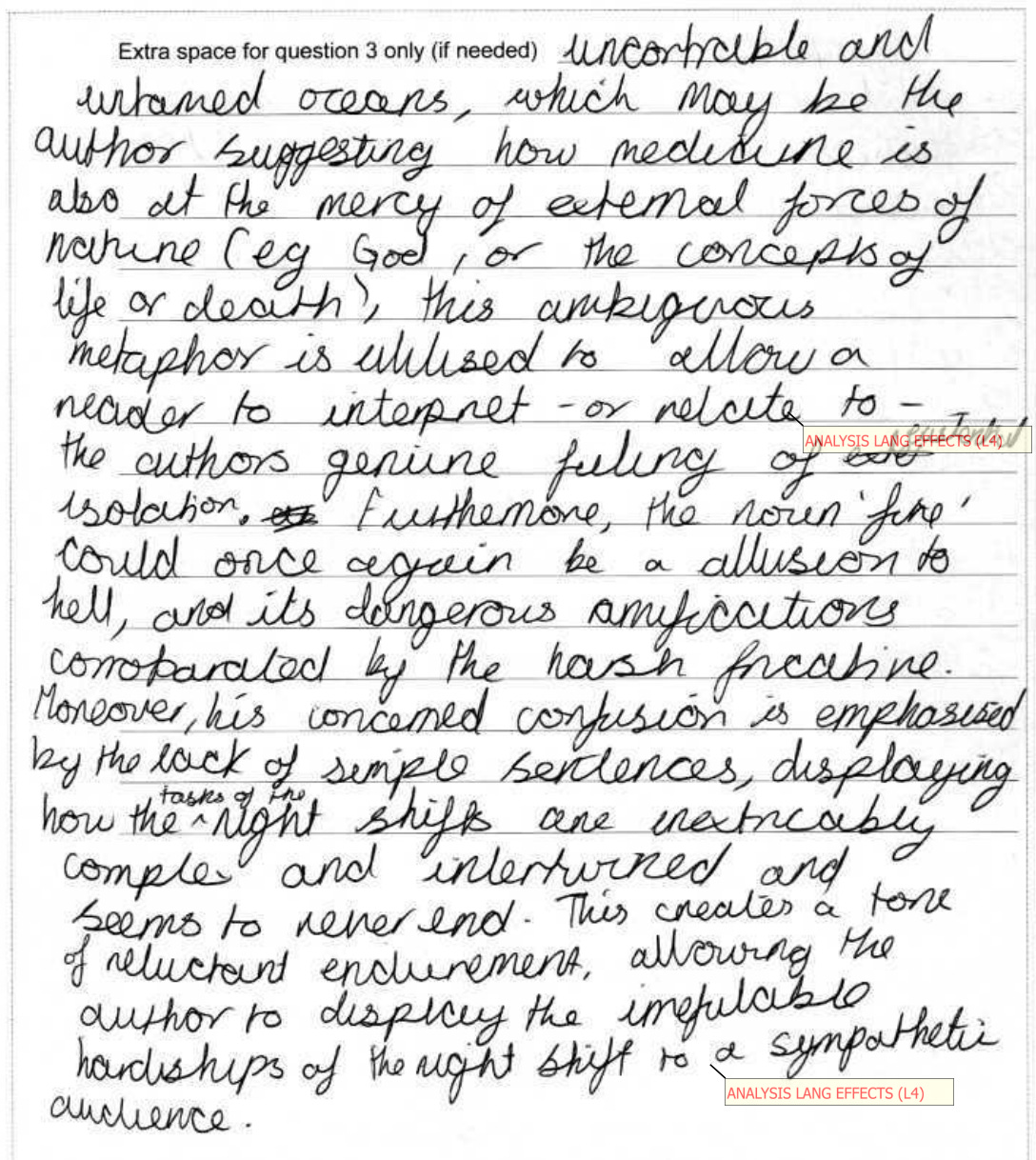
The author also utilises language to emphasise the isolation and concern of the author while during the night shifts at the hospital. He uses an extended metaphor of ‘a ship that’s enormous, and on fire, ... that no one has taught you how to sail.’ The adjective ‘enormous’ emphasises his almost microscopic presence of ‘one-man’ which could reflect his blatant confused mental turmoil. The ship could be the metaphorical presence of the hospital, which realistically is gigantic and formidable - the epitome of designed ingenuity to battle the seas, but a more nuanced exploration could suggest that the ship is actually powerless amidst the untamable and untamed oceans, which may be the author suggesting how medicine is also at the mercy of external forces of nature (eg God, or the concepts of life or death), this ambiguous metaphor is utilised to allow a reader to interpret - or relate to - the authors genuine feeling of isolation. Furthermore, the noun ‘fire’ could once again be a allusion to hell, and its dangerous ramifications corroborated by the harsh fricative. Moreover, his concerned confusion is emphasised by the lack of simple sentences, displaying how the tasks of the night shifts are inextricably complex and intertwined and seems to never end. This creates a tone of reluctant endurement, allowing the author to display the ineffable hardships of the night shift to a sympathetic audience.
My Comments
This student has been taught to write 2 chunky paragraphs. That is not why it gets the marks.
They have also been taught to begin each paragraph with a frame - the first sentence explains what the paragraph is going to be about. Senior Examiners look out for this, even though it is not in the mark scheme.
The first paragraph launches into an analysis or just one quote, and then zooms in on individual words within the quote. And then gives lots of explanations about the effect of the quote. You need to do this once in a top mark answer. An examiner may give you full marks for 12 quotes with 12 explanations, but they prefer it if the ratio is fewer quotes, more explanations.
This student has basically zoomed in on 2 long explanations. This is absolutely not necessary. But it does work if you are that kind of student.
This is a very long answer. Does a full mark answer need to be this long?
Let’s find out with Points Make Prizes - 12 valid explanations is enough for 12 marks.
Points Make Prizes
The writer uses language to describe working night shifts at the hospital as difficult to endure. Night shifts are an allegorical embodiment of trauma as they ‘made Hell look like Disneyland.’ The inferential allusion to ‘Hell’, describes his genuine suffering - even pain - during the night shifts. (1 mark)
Furthermore, the juxtaposition between ‘Hell’ and ‘Disneyland’, could reflect the journey of his life, this quote acts as a microcosm of his perilous descent from ‘buzzing’ about the idea of being a doctor to ‘essentially being a ‘glorified personal assistant’. (2 marks)
A more perceptive audience however may infer the reference to ‘Disneyland’ with a tone of regret for his wasted childhood; he worked endlessly to not find enjoyment - or lose his spark - in his occupation, this could evoke sympathy from an audience. (3 marks)
The childish semantic field is continued with the noun ‘nightmare’, labeling the author as a distressed child plagued by naive terror. (4 marks)
The author also utilises language to emphasise the isolation and concern of the author while during the night shifts at the hospital. He uses an extended metaphor of ‘a ship that’s enormous, and on fire, ... that no one has taught you how to sail.’ The adjective ‘enormous’ emphasises his almost microscopic presence of ‘one-man’ which could reflect his blatant confused mental turmoil. (5 marks)
The ship could be the metaphorical presence of the hospital, which realistically is gigantic and formidable - the epitome of designed ingenuity to battle the seas, (6 marks)
But a more nuanced exploration could suggest that the ship is actually powerless amidst the untamable and untamed oceans, (7 marks)
which may be the author suggesting how medicine is also at the mercy of external forces of nature (eg God, or the concepts of life or death). (8 marks)
This ambiguous metaphor is utilised to allow a reader to interpret - or relate to - the authors genuine feeling of isolation. (9 marks)
Furthermore, the noun ‘fire’ could once again be a allusion to hell, and its dangerous ramifications corroborated by the harsh fricative. (10 marks)
Moreover, his concerned confusion is emphasised by the lack of simple sentences, displaying how the tasks of the night shifts are inextricably complex and intertwined and seems to never end. (11 marks)
This creates a tone of reluctant endurement, allowing the author to display the ineffable hardships of the night shift to a sympathetic audience. (12 marks)
So yes, the answer did need to be this long!