
How Does Stevenson Present Utterson?
Grade 9 Essay for FREE

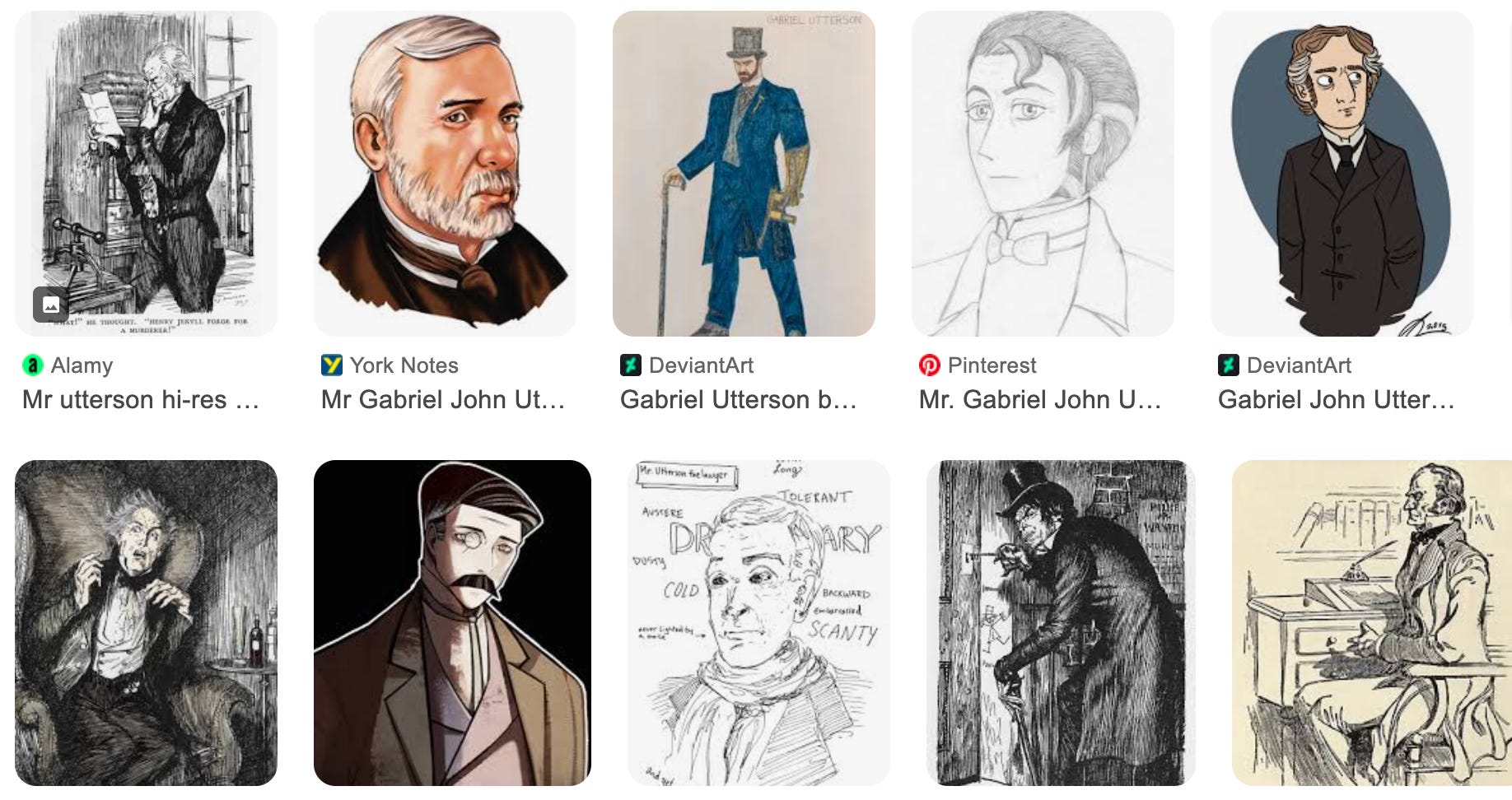
A reader, Katherine, asked what grade this would get:
The Strange Case of Doctor Jekyll and Mr. Hyde (Jekyll and Hyde) is fundamentally a novella focusing on repression in the upper class of Victorian gentlemen and its consequences. Within this extract, Utterson is presented as, similar to many of the other characters in the novella, conflicted between societal respectability and the temptation to indulge his curiosity in base, natural desires. Stevenson, by telling the story through his eyes, may intend to emphasize that the standard of societal repression is unattainable, and that such repression is the reason why monsters like Hyde can claim territory within London.
Utterson’s conflicting characteristics are at first displayed by the dissonance between the hollow shell of the life he is supposed to live and the behaviors he is constantly drawn to. For example, in this extract, he is described as “lean, long, dusty, dreary and yet somehow loveable.” Firstly, there is a strange contrast between a list of negative adjectives and “loveable”, showing how Utterson is well respected and popular within society, perhaps due to the very repression that renders him “dusty” and “dreary”. The repeated “d” sounds create an unrelenting rhythm, which could emphasize the fact that Utterson has been this way for a long time, and therefore that the environment he has lived in has forced him into that state. This is emphasized by the fact that “dusty” and “dreary” suggest neglect, age, and lifelessness, perhaps conveying to the reader that Utterson, through his behaviors and his outward following of societal expectations, has cost him a more natural appearance and way of life.
This is starkly contrasted with Hyde’s description, being “pale and dwarfish” and portrayed as much younger than Jekyll. Hyde, in contrast to Utterson, accepts wholeheartedly and follows his natural instincts towards deviance, suggesting that the contrast between Utterson and Hyde results in Utterson being worn physically, meanwhile Hyde is young and agile. His embracing of his own natural desires may allow him to lead a more carefree life, which is why Stevenson could’ve chosen to portray him as younger and contrasting to Utterson’s weary nature.
Utterson is also clearly described as being religiously conflicted, as he reads his “dry divinity” frequently. This refers to religious text, implying that Utterson views his faith as something unengaging. This is ironic because Utterson is described as living next to “the neighbouring Church” and therefore on the outside being a model devotee. However, this may be seen as normal for London, as a lack of engagement within true religion is a pattern within it, since even the streets are described as “empty as a Church,” therefore implying that Church attendance is low. Therefore, Utterson seems to embody the average upper-class Victorian gentlemen, who portrays a model of religious devotion on the outside but actually only engages in its restrictive elements to gain a good name within society, as was normal in actual society at the time.
Utterson’s restrictive nature could be displayed as he drinks “gin” when he was alone, which would have been considered a drink more for the lower class, representing his fascination with the element of freedom that comes with not being respected and therefore forced to be respectable. This is contrary to what would’ve been expected to be enjoyed at the time, as religious scriptures find no appeal to Utterson, who instead takes pleasure in cheap alcohol, displaying parts of his curiosity sometimes becoming a private temptation.
This also permeates into his work, as he is a renowned and respected lawyer. This could be why the novella has a somewhat legalistic structure, as it is within Utterson’s perspective that the mystery is being solved. For example, when talking about his work with criminals “he always sought to help rather than to reprove”, perhaps implying that he doesn’t treat a criminal’s deviance with the criticism normal to the time. He also is cited as the “last good influence in the lives of going down men” which implies that when everyone else has left the criminals he will happily continue to work with them and help them. This could be interpreted as due to an innate but professional curiosity towards transgression, which he finds easily within his job. Work is the main way to give back to society, and therefore Utterson’s allows him proximity to deviance, and watch transgression rather than take part of it. This displays how he is always stretching and testing the confines of society to accommodate his curiosity without ostracizing himself like Jekyll did.
However, Jekyll, in Chapter Ten, is also described as using his work as a way to explore forbidden desires, as he cites himself working with the “mystic and the transcendental”. Science within Victorian society was strictly guarded from new ideas, as displayed by Lanyon, a highly renowned surgeon, living in a “citadel” of medicine, “citadel” implying an ancient force of defense against external forces. Therefore Jekyll breaching this confinement and exploring new ideas displays how this was entirely forbidden in the time and also implies that Utterson himself is a counterpart to Jekyll, as he also fights the same war between societal expectations and his own natural desires, albeit in a much more restrained fashion. The two could be perceived as a mirror of each other, as the book makes aware that no other character but Utterson would be capable in solving the mystery, as he is so similar to Jekyll in terms of the battle they fight that anyone else would have abandoned the case and let societal repression completely win over them.
Additionally, Utterson’s conflicting characteristics are displayed by his outwards judgement, but secret fascination with the deviance and transgression Hyde embodies, uniting him with characters such as Lanyon to present this as a common and unavoidable fate for Victorian gentlemen. For example, when Utterson goes to bed, he is displayed as “soberly and gratefully” doing so. “Soberly” contrasts with the description of him drinking gin when he is alone, implying that even after consuming alcohol, he doesn’t allow himself to be drunk, as he cannot risk any impairment of his moral reasoning. This mirrors his almost unnatural repression. “Gratefully” could be implied as following the Christian tradition of thankfulness, however it could also be interpreted as gratefulness from Utterson for another reason, perhaps that he might be able to escape the constant standards of repression he lives around.
This could be further emphasized in his nightmare, as he watches vivid scenes of Hyde “gliding through sleeping houses.” Sleep is traditionally viewed as a form of innocence since one lacks the reason they do when they are awake. However, “gliding” implies making one’s way in with a lack of force, therefore emphasizing how easily Hyde is able to corrupt this supposed innocence, even with Utterson himself. This may be because of Utterson’s constantly restrained and repressed curiosity that he refuses to indulge in the day, but at night can roam free due to Hyde’s infiltration of innocence. The fact that he is grateful for this emphasizes how curious Utterson is to explore moral deviance.
The maintaining of Utterson’s perspective earlier in the novella strategically limits the reader’s knowledge of the supernatural, therefore allowing them to indulge in their own curiosity towards Jekyll’s case. However, the epistolary form of the novella means that Lanyon and Jekyll are allowed to tell their own stories, emphasizing the fact that despite endless repression, the truth will always eventually come to light. This presents Utterson as a mirror of the reader as he is curious as well but hides under a facade of judgement of moral deviance. This facade is displayed through many descriptions of Hyde, as he describes him as “stumping eastwards”, a reference to the east colonies Britain occupied at the time and how they were seen as inferior to England. The East was considered non-Christian, therefore presenting them as less morally upright in Victorian society.
Utterson describing Hyde this way may link to traditional Victorian fears of the unknown as being a place without morality. This is ironic, as Hyde is very clearly described infiltrating London, suggesting that perhaps the East is more innocent of any crime against morality than the very city Utterson resides in.“Stumping” is also a verb that could allude to an unnatural way of walking, emphasizing how strangely Utterson sees Hyde. Since the novella is told in third person limited within his perspective, the narration very obviously describes his judgemental nature. However, considering the differences in their physical appearances earlier explored through the novella, Utterson may actually see Hyde’s actions and movements strange as Hyde is youthful and Utterson is not, linking to Utterson’s weary nature and Hyde’s lack of responsibility or conscience.
Additionally, Utterson is influenced by characters such as Dr. Lanyon to distance himself from transgression, and therefore Utterson’s actions and views on the world may have been subtly influenced by Lanyon. For example, Utterson, when seeking more information on the case, states that “if anyone knew it must be Lanyon” displaying how Utterson relies on even more conservative characters such as Lanyon for information. Similar to Lanyon’s own narrow-minded views on the world, Utterson only accepts true scientific information from Lanyon, who represents scientific stagnancy, therefore launching Utterson deeper into the judgement that comes with societal repression. This may explain why Utterson had never visited Jekyll’s lab before beginning to uncover the case, as he followed Lanyon’s influence. Coming close to deviance such as that expressed by Hyde begins to break this influence as he goes to Jekyll’s lab eventually, displaying the war between the influence of society and the allude of transgression.
Ironically, Dr. Lanyon, who is perhaps more conservative that Utterson, is eventually overwhelmed by his own curiosity to the scientific deviancy that birthed Hyde. This links to the facade of religion guiding society, as Lanyon cries out “O God” but no God comes, suggesting that the true God that characters such as the high class Victorian gentlemen in Jekyll and Hyde worship, is the strict moral code and emphasis on reputation created by the high-pressure environment of society. This explains why characters seem so pious, but Church attendance is demonstrated to be low, and many, like Utterson express minimal interest in holy texts. This all links back to Utterson as Lanyon’s downfall displays how the behaviors Utterson tries to engage him could truly just be a weak shield to hide Utterson’s mounting curiosity in regards to breaking societal standards. Even those that influence him fall eventually to indulging their natural desires with deadly consequences.
Therefore, Lanyon’s journey from influencing Utterson against Jekyll to eventually falling to the same vices as Jekyll did shows how Utterson’s judgemental nature is shaped by the outside forces of society, rather than a genuine motivation within him. Stevenson may have been doing this in order to emphasize to the reader that the perceived piousness present in society was all an act to mask forbidden curiosity and evil deeds, and therefore portrays Utterson as both highly influenced and highly curious. This again links to the fact that no other character but Utterson could’ve uncovered the mystery, as he, like other gentlemen, cannot truly escape the temptation towards exploration of deviance, but he can restrain and repress it. Therefore Utterson could function as a relatable character to readers, even if they are unwilling to admit such a thing, as they likely struggled with the same temptations as Mr. Utterson.
In conclusion, Stevenson presents Utterson as conflicted between his curiosity and his judgement, as well as between his repression and his small, secret, restrained indulgences. He does this as a necessity, to convey to the reader that there is no true way to completely escape the natural instinct of deviance, no matter how repressive one is. One could also argue that he presents Utterson this way as the character he possesses is integral to the plot, since his deeply conflicted nature enables him to explore the case without submitting completely like Lanyon or Jekyll.
I have never seen an essay this long not score a grade 9! In fact I’ve never seen one score less than 30/30.
I asked Gemini to consider this:
Thoughts on the Quality of the Argument and Analysis
This is a high-level, sophisticated piece of literary analysis. It moves beyond simple character description into “conceptualized” territory, meaning it treats the characters as symbols used by the author to explore Victorian themes.
Strengths:
Nuanced Understanding of Utterson: You have successfully identified that Utterson is not just a “boring lawyer.” Your analysis of his “professional curiosity towards transgression” is an excellent point that markers look for—the idea that he uses his job to look at the “dark side” without getting his own hands dirty.
Structural Awareness: Your point about the “legalistic structure” of the novella being a result of Utterson’s perspective is brilliant. It shows you understand how narrative form and character are linked.
Contextual Integration: You weave in Victorian fears (the East/Colonialism, the “citadel” of traditional science, the New Poor Law/workhouse-era religious hollows) very naturally.
Linguistic Analysis: Your focus on the plosive repeated “d” sounds in “dusty and dreary” and the significance of the verb “gliding” shows a close attention to Stevenson’s craft.
Areas for Improvement:
Differentiating Jekyll and Utterson: You describe them as “mirrors,” which is true, but ensure you emphasize the difference in their results. Jekyll attempted to physically separate his duality, whereas Utterson lives with his duality successfully through repression. This is the “safe” vs. “dangerous” way of being a Victorian gentleman.
Overall Grade Potential: This would comfortably sit in the top mark band (Grade 8/9 for GCSE) because of its conceptual focus on repression and vicarious curiosity.
Tilf Gives it a Grade 9
What Went Well
The essay demonstrates a deep understanding of Utterson’s character and the themes of the novella, particularly regarding repression and curiosity.
The use of textual references is generally effective, with some strong analyses of specific passages that illuminate Utterson’s complexities.
The connections made between Utterson and other characters, such as Hyde and Jekyll, provide a nuanced understanding of the interpersonal dynamics and thematic implications within the novella.
Even Better If
Incorporate more direct quotes from the text to support your analyses, as this will strengthen your arguments and provide clearer evidence for your claims.
Make sure to explicitly link your analyses back to the main question throughout the essay, ensuring that each point contributes to the overall argument about Utterson’s complexity.
Consider providing more context about Victorian society and how it influences Utterson’s character, as this will enhance your exploration of the themes and deepen your analysis.
AO Feedback
To improve AO1, focus on maintaining a clear thesis statement throughout the essay that directly addresses the question. This will help guide your analysis and ensure that all points are relevant to the task.
For AO2, ensure that you are using textual evidence effectively to support your claims. Incorporate more direct quotes and analyze their significance in relation to Utterson’s character and the themes of the novella.
In terms of AO3, deepen your exploration of the contextual factors surrounding Utterson’s character. Make explicit connections between his personal struggles and the broader societal issues of the Victorian era, particularly regarding repression and morality.
Mark 25
AO1 10/12
AO2 9/12
AO3 6/6
Hi, I was wondering if you had any predictions or guidance for OCR English Literature Paper 2? Esp poetry and Macbeth predictions
thank you mr salles, highly appreciated :)