
How Does Dickens Present the Theme of Redemption?

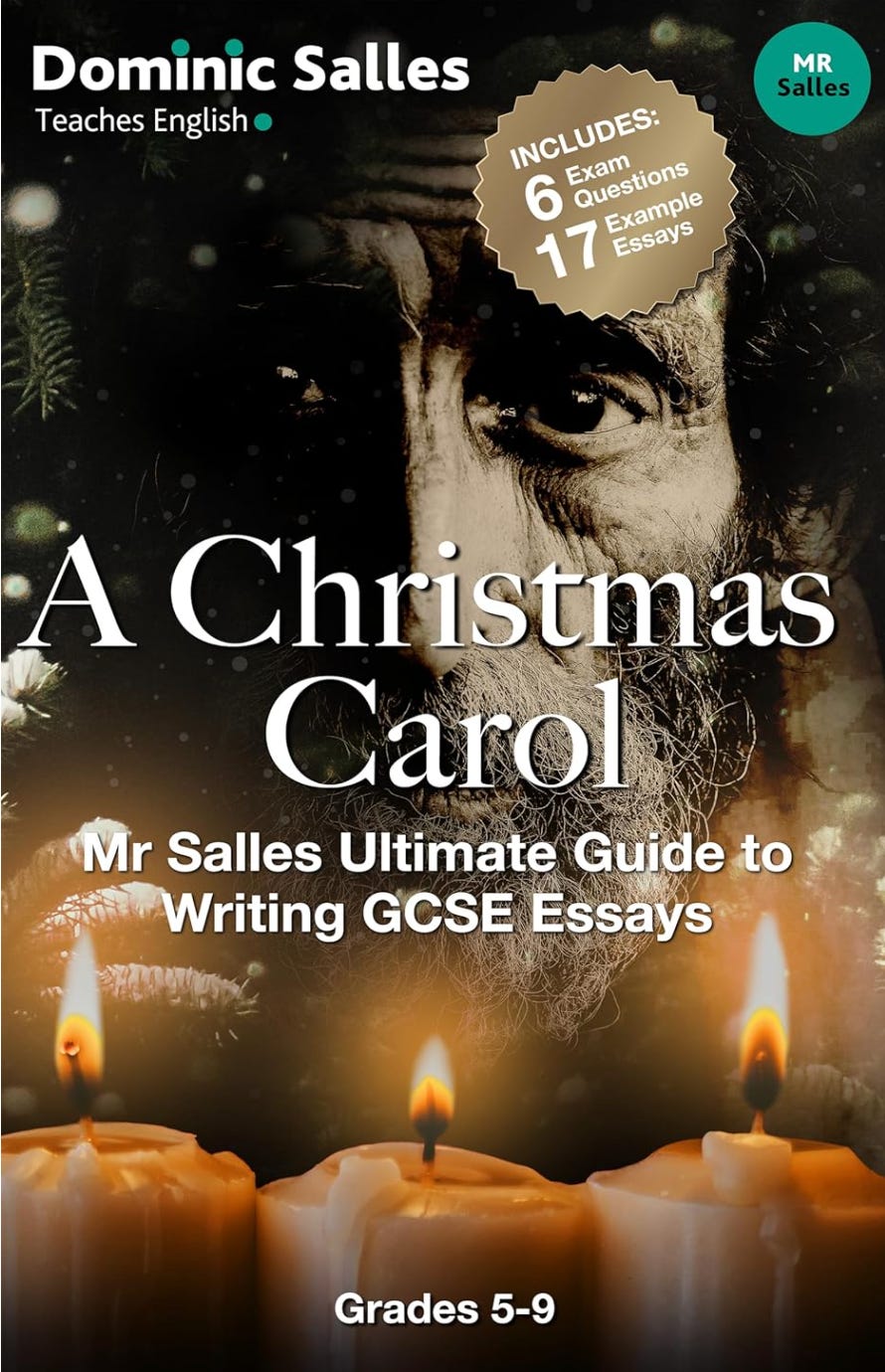
For a Christmas post, I had to give you A Christmas Carol.
I actually recorded the novel as an audio book three years ago, and put it up for free on YouTube. You can listen to Stave 1 here. Some teachers have started to play it to their classes for Christmas (and some students have told me that is not so bad!)
Now for some top grade stuff. We’re going to dive into super efficient revision and essay writing.
Imagine this extract:
Extract for the Redemption Question
“Before I draw nearer to that stone to which you point,” said Scrooge, “answer me one question. Are these the shadows of the things that Will be, or are they shadows of things that May be, only?”
Still the Ghost pointed downward to the grave by which it stood.
“Men’s courses will foreshadow certain ends, to which, if persevered in, they must lead,” said Scrooge. “But if the courses be departed from, the ends will change. Say it is thus with what you show me!”
The Spirit was immovable as ever.
Scrooge crept towards it, trembling as he went; and following the finger, read upon the stone of the neglected grave his own name, Ebenezer Scrooge.
“Am I that man who lay upon the bed?” he cried, upon his knees.
The finger pointed from the grave to him, and back again.
“No, Spirit! Oh no, no!”
The finger still was there.
“Spirit!” he cried, tight clutching at its robe, “hear me! I am not the man I was. I will not be the man I must have been but for this intercourse. Why show me this, if I am past all hope!”
For the first time the hand appeared to shake.
“Good Spirit,” he pursued, as down upon the ground he fell before it: “Your nature intercedes for me, and pities me. Assure me that I yet may change these shadows you have shown me, by an altered life!”
The kind hand trembled.
“I will honour Christmas in my heart, and try to keep it all the year. I will live in the Past, the Present, and the Future. The Spirits of all Three shall strive within me. I will not shut out the lessons that they teach. Oh, tell me I may sponge away the writing on this stone!”
In his agony, he caught the spectral hand. It sought to free itself, but he was strong in his entreaty, and detained it. The Spirit, stronger yet, repulsed him.
Holding up his hands in a last prayer to have his fate reversed, he saw an alteration in the Phantom’s hood and dress. It shrunk, collapsed, and dwindled down into a bedpost.
I’ve nearly finished designing a course for a school that wants to revise A Christmas Carol with students aiming for grades 3 to 9. I will eventually release this on my website.
If you want to learn how to write essays at each grade, I’ve already published that as this guide to A Christmas Carol essay writing.
As you know, I’m obsessed with top grades, and teaching for lower grades has been both very interesting and creative.
My first thought was, can I teach how to get grade 9 with the same 10 quotes I would teach to students aiming for a grade 3? The answer is yes.
Here they are:
The Only 10 Quotes You Will Ever Need (though you can have as many as you want)
"Oh! But he was a tight-fisted hand at the grindstone, Scrooge! a squeezing, wrenching, grasping, scraping, clutching, covetous old sinner!"
"I don't make merry myself at Christmas and I can't afford to make idle people merry."
"Are there no prisons?" said the Spirit, turning on him for the last time with his own words. "Are there no workhouses?"
"What then? If he be like to die, he had better do it, and decrease the surplus population."
"Mankind was my business … The dealings of my trade were but a drop of water in the comprehensive ocean of my business!"
"Bear but a touch of my hand there," said the Spirit, laying it upon his heart, "and you shall be upheld in more than this!”.
"Father is so much kinder than he used to be”
"Spirit," said Scrooge, with an interest he had never felt before, "tell me if Tiny Tim will live."
"This boy is Ignorance. This girl is Want. Beware them both, and all of their degree, but most of all beware this boy, for on his brow I see that written which is Doom, unless the writing be erased."
“and to Tiny Tim, who did not die, he was a second father.”
Number 6 is a bit rogue. Occasionally I swapped it out for this one:
“Another idol has displaced me … a golden one”.
Then I’ve taught those quotes in ways which make them memorable. Next I’ve shown how much, or how little, you need to analyse them to get the grades. Obviously, they are dripping with methods, like an oil spill.
I Tested Them By Writing Essays
Grade 3, 4, 5, 6, 7, 8 and 9 version of the same essay. Then I did the same for two more themes, just to see if it would work. 21 essays!
It really did.
Don’t forget, the extract is crammed with quotes, so there is no difficulty getting to the 13 which grade 9 answers average. (I’m only counting the long quote here, not the individual word analysis which can boost this total quite a bit. But, the challenge I set myself was that this analysis will still come from these quotes or the ones in the extract. That’s it - nowhere else).
Here is a Grade 4 Essay Answering The Question
At the beginning of A Christmas Carol, Scrooge is a really mean person. Dickens describes him as “a squeezing, wrenching, grasping, scraping, clutching, covetous old sinner!” This shows that Scrooge loves money more than anything. He is also unkind to the poor, saying, “Are there no prisons? ... Are there no workhouses?” He thinks poor people are lazy and should be punished. This is a view that lots of Victorian readers had at the time.
But then three ghosts visit Scrooge. The Ghost of Christmas Past shows him how he lost his love, Belle, because he loved money too much. He worshipped money like an “idol”. The Ghost of Christmas Present shows Scrooge the happy Cratchit family, who manage to be happy even though they are poor. Scrooge sees Tiny Tim, a sick child, and starts to worry about him. He asks the Ghost, “tell me if Tiny Tim will live”. This shows that Scrooge is starting to care about other people. This is the start of his redemption.
The Ghost of Christmas Yet to Come shows Scrooge what will happen if he doesn’t change. He sees that people steal his things after he dies, and no one cares. Scrooge sees his own grave and realizes that no one loves him. He is very scared and wants to change his life.
In the extract Scrooge sees his grave and realises that no one cares about him. This makes him want to change. He begs “hear me! I am not the man I was”. This shows us that he thinks he can change and so he is begging for the chance to prove it.
He promises the ghost, saying “I will honour Christmas in my heart”. This tells us that he will change because he understands that being generous is not just for Christmas.
“Why show me this, if I am past all hope? Assure me that I yet may change these shadows you have shown me, by an altered life!” This shows how much Scrooge wants to be a better person. He believes he can change.
The ghosts help Scrooge to change. He wakes up on Christmas morning a different man. He decides to be kind and giving, which shows his redemption. He sends a turkey to the Cratchits and gives money to charity and he gives Bob a pay rise. He is like “a second father” to Tiny Tim, who stays alive because of Scrooge.
Dickens shows us that even someone as mean as Scrooge can change. Scrooge learns that being greedy and selfish makes you unhappy, but being kind and giving makes you happy. The story reminds us to be kind to others, especially during Christmas, but also for the rest of the year.
My Comments
In some ways this is better than a grade 4 essay. These rarely have a conclusion, but you can see that the last paragraph is a conclusion.
This is actually inevitable if you follow The Mr Salles Method, which is this:
Write the essay chronologically, dealing with the extract when it appears in the story.
This is sooo important, because it means that you automatically write about how Scrooge changes, and so does our understanding of the theme. This makes a higher grade automatic.
It means that when you get to the last paragraph, you automatically start to explain what Scrooge was up to. This does mean that the essay is partly “a focused response to the full task which demonstrates clear understanding” which is grade 5. But, I’m ok with that. If students learn how to write a grade 4 essay which is partly grade 5, that seems like a good idea.
Especially as the final paragraph will fit any essay on any theme - so that grade 4 student can guarantee that part of their essay is grade 5.
You also need quite a few ‘references’ to the text for AO1. These don’t have to be quotes. Notice how many references to events there are in the penultimate paragraph. Easy marks, and another paragraph that a grade 2, 3, or 4 writer could easily memorise.
Let’s see how the essay changes at grade 7.
Grade 7 Version
Dickens presents Scrooge’s transformation in A Christmas Carol. Scrooge’s redemption is a symbol for how Dickens wants Victorian society to change, to become generous to the poor and to feel sympathy for their suffering.
The opening description of Scrooge as "a squeezing, wrenching, grasping, scraping, clutching, covetous old sinner!" uses a LIST OF VERBS with harsh "-ing" endings to emphasise how hard it is for Scrooge to let go of his greed. The damaging nature of his greed is also emphasised by the harsh alliteration of “clutching, covetous”.
He refuses to give to charity, with RHETORICAL QUESTIONS, asking, "Are there no prisons? ... Are there no workhouses?" This reveals his cruel belief that the poor are “idle people”. He sees them as failing morally, so they deserve to be punished rather than helped. Dickens shows us just how cruel this is when Dickens makes Scrooge have the same views as Victorians at the time. Consequently, if the poor don’t like the “workhouses” Scrooge says they could choose to “to die … and decrease the surplus population." He believes the Poor Laws create this Malthusian lack of care for the poor which is cruel and uncivilised.
First Marley teaches him that “mankind was my business”. This METAPHOR teaches Scrooge that looking after “mankind” is more important than money and greed. Then Dickens uses the ghosts to teach Scrooge why Marley is right. The Ghost of Christmas Past reveals what happened in Scrooge’s past to make him so cruel. Then he CONTRASTS how Scrooge used to feel love for his sister Fan. He also CONTRASTS it with the love he used to have for Belle, until his greed and cruelty took over: "Another idol has displaced me ... A golden one". This RELIGIOUS language shows that Scrooge’s greed is wrong, because an “idol” is a false God, not the Christian one.
The Ghost of Christmas Present also shows Scrooge a CONTRAST when they visit the Cratchit family's joyful celebration of Christmas, despite their poverty. Dickens emphasizes the Cratchits' resilience and determination to see the good in everything, even him. Scrooge is visibly moved by Tiny Tim's fragile health: "Spirit," said Scrooge, with an interest he had never felt before, "tell me if Tiny Tim will live". This question reveals the beginning of Scrooge’s redemption, which starts with seeing the poor as human. The strong ALLITERATION of "tell me if Tiny Tim will live," emphasises how strongly he feels the poor should be helped. The SIBILANCE addressing the “Spirit” is soft, and reflects how Scrooge’s harsh views are changing.
The ghost replies with an attack on Scrooge’s old Malthusian views of the poor. He uses Scrooge’s past words against him, "What then? If he be like to die, he had better do it, and decrease the surplus population". Then the ghost reveals the PERSONIFIED figures of "Ignorance" and "Want" beneath his robes. The spirit warns Scrooge, "This boy is Ignorance. This girl is Want. Beware them both, and all of their degree, but most of all beware this boy, for on his brow I see that written which is Doom". This highlights Dickens’ view that society will be damaged if the poor are not educated.
In the extract, Scrooge sees his grave and realises that no one cares about him. This makes him want to change. He begs “hear me! I am not the man I was”. This shows us that he thinks he can change and so he is begging for the chance to prove it.
He promises the ghost, saying “I will honour Christmas in my heart”. This tells us that he will change because he understands that being generous is not just for Christmas. The use of “heart” is a MOTIF in the novel which Dickens uses to show how his readers should react positively to the suffering of the poor.
He asks “Why show me this, if I am past all hope? Assure me that I yet may change these shadows you have shown me, by an altered life!” This EMOTIVE LANGUAGE and REPETITION create a desperate TONE. This emphasises the power of his desire to change his fate and become a better man.
Scrooge's awakening on Christmas morning reveals a complete transformation. He embraces the spirit of Christmas, sending a prize turkey to the Cratchits and making a generous donation to charity. Scrooge also realises the importance of family, as he accepts Fred's invitation to Christmas dinner, and he becomes a "second father" to Tiny Tim, whose life he has saved. He saves this life by becoming a more generous employer, like Fezziwig. The increase in wages he gives to Bob Cratchit allow him to keep his whole family healthy. This suggests that employers have to change too.
In conclusion, Dickens uses the traditions of Christmas to show that love, kindness, and generosity are necessary, especially at Christmas, but all year round. He criticises the MALTHUSIAN VIEWS which wanted to “decrease the surplus population”. Scrooge's redemption encourages readers to show compassion and take responsibility for helping others, both as individuals and as employers.
My Comments
So much of getting a top grade is having a strong thesis statement and conclusion.
This is probably better than a grade 7. But, when students have read the grade 5 and 6 versions, those who want a grade 7 will find it easy to write like this.
Writing about society and Malthusian is an easy thing to do - these always predict at least grade 7 ideas. Too many gets you into grades 8 and 9, so I had to hold myself back.
I’ve probably written about too many methods here for just a grade 7 too. I think the comments on CONTRAST and Fan are probably more than the grade 7 needs. You probably don’t need Belle.
But here’s the thing. You’ve learned these quotes. And you are damn well going to shoe horn them into your essay aren’t you?
So, the student aiming for a grade 7 might accidentally write a grade 8 essay. I can live that.
Grade 9 (Full Mark)Version
Dickens presents Scrooge’s transformation in A Christmas Carol. Scrooge’s redemption is a symbol for how Dickens wants Victorian society to change, to become generous to the poor and to feel sympathy for their suffering. It is a plea for social responsibility.
The opening description of Scrooge with "Oh! But he was a tight-fisted hand at the grindstone, Scrooge! a squeezing, wrenching, grasping, scraping, clutching, covetous old sinner!" The ALLITERATION of harsh consonants “t” and “d” in “tight-fisted hand at the grindstone” emphasise Scrooge’s cruelty and lack of empathy. The LIST OF VERBS describing him as "a squeezing, wrenching, grasping, scraping, clutching, covetous old sinner!" emphasise how hard it is for Scrooge to let go of his greed, as his avarice appears relentless. The damaging nature of his greed is also emphasised by the harsh alliteration of “clutching, covetous”. The Christian reference to “sinner” reminds us that Scrooge needs to redeem himself to save his soul.
That level of writing about methods in a quote is not necessary for a grade 9.
I tell students they don’t need to do this, which is true.
But, because the course is about only 10 quotes, most students would be able to learn this level of analysis. So, you know, why not? It’s free marks, so long as you have fast handwriting.
That thesis statement - easy to copy and use with any question.
Paid subscribers get a grade 9 answer every week except the summer holidays, to add to the 90+ already published.
All the revision you will ever need, all in one place. Free for the first week, because Substack knows there is over a 90% chance you will stay subscribed.
He refuses to give to charity, with RHETORICAL QUESTIONS, asking, "Are there no prisons? ... Are there no workhouses?" This reveals his cruel belief that the poor are “idle people”. He sees them as failing morally, so they deserve to be punished rather than helped. Dickens shows us just how cruel this is when Dickens makes Scrooge have the same views as Victorians at the time. Consequently, if the poor don’t like the “workhouses”. Scrooge says they could choose to “to die … and decrease the surplus population." He believes the Poor Laws create this Malthusian lack of care for the poor which sees them as a burden on society. Dickens shows this is cruel and uncivilised.
There is a whole heap of language analysis you could write about the first and last quotes in this paragraph.
But, points make prizes.
You need to move through the novel, to show how the theme develops. Sure, you will get great AO2 marks if you keep analysing quotes in detail, but this will stop you effectively dealing with AO1 ‘whole task’ and AO1 ‘references’. Why? Because you won’t be able to write enough to get there. So, it will actually hold you back.
Poor Laws, Malthusian, society - top grade AO3 context all day.
First Marley teaches him that “mankind was my business”. This METAPHOR teaches Scrooge that looking after “mankind” is more important than money and greed. Then Dickens uses the ghosts to teach Scrooge why Marley is right. The Ghost of Christmas Past reveals what happened in Scrooge’s past to make him so cruel. Then he CONTRASTS how Scrooge used to feel love for his sister Fan. He also CONTRASTS it with the love he used to have for Belle, until his greed and cruelty took over: "Another idol has displaced me ... A golden one". This RELIGIOUS language shows that Scrooge’s greed is wrong, because an “idol” is a false God, not the Christian one.
Working through the novel chronologically also helps you write about the structure - most students won’t do this. It is an easy way to be ‘convincing’, because you are saying, ‘look, I’m not just great at analysing the language, I’m also showing you how the structure affects the meaning of the novel.
The easiest way to write about structure? Write about the beginning and the end, and show the change between the two.
And, if you always look for CONTRAST, you’re always looking for grades 8 and 9.
The Ghost of Christmas Present also shows Scrooge a CONTRAST when they visit the Cratchit family's joyful celebration of Christmas, despite their poverty. Dickens emphasises the Cratchits' resilience and determination to see the good in everything, even him. Scrooge is visibly moved by Tiny Tim's fragile health: "Spirit," said Scrooge, with an interest he had never felt before, "tell me if Tiny Tim will live". This question reveals the beginning of Scrooge’s redemption, which starts with seeing the poor as human. The strong ALLITERATION of "tell me if Tiny Tim will live," emphasises how strongly he feels the poor should be helped. The SIBILANCE addressing the “Spirit” is soft, and reflects how Scrooge’s harsh views are changing.
See, CONTRAST is everywhere when you start looking.
Too much analysis of “tell me if Tiny Tim will live” - you don’t need both alliteration and sibilance.
But, as before, you only have 10 quotes to remember, so it is easy to memorise the analysis and slip it in. (So long as you write fast!)
The ghost replies with an attack on Scrooge’s old Malthusian views of the poor. He uses Scrooge’s past words against him, "What then? If he be like to die, he had better do it, and decrease the surplus population". Then the ghost reveals the PERSONIFIED figures of "Ignorance" and "Want" beneath his robes. The spirit warns Scrooge, "This boy is Ignorance. This girl is Want. Beware them both, and all of their degree, but most of all beware this boy, for on his brow I see that written which is Doom". This METAPHOR of "Doom" highlights Dickens’ view that society will be damaged if the poor are not educated and helped out of poverty.
Look at this paragraph. Is there any essay where this wouldn’t fit?
I don’t think so. You could learn it and use it, whatever the essay. That’s the thesis statement, the conclusion and this, all ready to splurge on the page no matter what the question.
Easy marks.
The Ghost of Christmas Yet to Come presents Scrooge with a bleak vision of his future if he remains unchanged. He sees the indifference surrounding his death, the theft of his possessions, and the loneliness of his forgotten grave. This is a powerful warning, emphasising the futility of a life driven solely by greed and a failure to look after others. Although the transformation began with his concern at the death of Tiny Tim, the shock of his own death is the catalyst for immediate change.
This paragraph is all about Dickens’ purpose and message. That’s where top grades live.
But it is also another way to look at the structure - when the transformation started compared to the catalyst that completes it.
This is what I mean about writing chronologically. It is a superpower that helps you get top grades.
In the extract, Scrooge is overcome with fear and remorse. He pleads for a second chance, demonstrating a genuine desire for change. He begs “hear me! I am not the man I was”. This shows us that he believes he can be redeemed and so he is begging for the chance to prove it.
He promises the ghost, saying “I will honour Christmas in my heart”. Dickens wants us to understand that being generous is not just for Christmas, but a year round necessity which Victorian society needs. The use of “heart” is a MOTIF in the novel which Dickens uses to show how his readers should react positively to the suffering of the poor. Transforming society begins with personal change.
The essay doesn’t need the first paragraph.
The second one earns its keep - motif, transformation, society, society again. Money in the bank.
Scrooge is desperate for this chance to change, asking “Why show me this, if I am past all hope? Assure me that I yet may change these shadows you have shown me, by an altered life!” This EMOTIVE LANGUAGE and REPETITION create a desperate TONE. This emphasises the power of his desire to change his fate and become a better man.
This is another way to bag marks quickly with a quote. No diving into language analysis, just a list of methods linked to tone.
Tone is always a grade 8 and 9 word, if you link it to the writer’s purpose.
Scrooge's awakening on Christmas morning reveals a complete transformation. He embraces the spirit of Christmas, sending a prize turkey to the Cratchits and making a generous donation to charity. Scrooge also realises the importance of family, as he accepts Fred's invitation to Christmas dinner, and he becomes a "second father" to Tiny Tim, whose life he has saved. He saves this life by becoming a more generous employer, like Fezziwig. The increase in wages he gives to Bob Cratchit allow him to keep his whole family healthy. This suggests that employers have to change too.
This paragraph highlights another aspect of the novel’s structure. Fezziwig only exists to teach how employers in society should behave, not just Scrooge.
In my guide I make much more of this.
Similarly, I’m slightly obsessed with the idea of fatherhood in the novel, and patterns of attachment caused by Scrooge’s childhood.
I’ve left all that out here, because the course is all about the fastest way to get each grade. You don’t have to remember or know too much at all.
In conclusion, Dickens uses the traditions of Christmas to show that love, kindness, and generosity are necessary, especially at Christmas, but all year round. He criticises the MALTHUSIAN VIEWS which wanted to “decrease the surplus population”. Scrooge's redemption encourages readers to show compassion and take social responsibility for helping others. The ghosts achieve this by changing his heart: "Bear but a touch of my hand there," said the Spirit, laying it upon his heart, "and you shall be upheld in more than this!” And so Scrooge’s redemption tries to touch the “heart” of the reader.
Well, if you are going to use the motif of the heart in your essay, the final quote is the perfect ending.
This is a better conclusion than you actually need for full marks, but I had to use all 10 of my quotes.